I read about three mile island incident couple of months ago and how that one incident stopped the whole nuclear power initiative of being a major source of power generation in USA.
When I was reading that – I realized the similarity between 70s of USA and current phase of India. It’s an interesting phase for a country which has initiated many infrastructure related projects and is very optimistic about those projects playing a big role in their growth story.
One more thing I realized was that USA has very stringent safety laws about these infrastructure projects (i guess those must be in 70s too) for everything, especially as compared to India. So – in spite of all those measures in place – the three mile accident happened!
Compare that to current situation in India where thousand of infrastructure projects are undergoing in all direction. The safety measures I dont know are how much stringent and how much followed. So isnt probability of a three mile similar incident happening in India now is much more that than that happening in US in 70s?? (I can only pray that such an event doesnt happen and our government has learned from all such infra accidents, including the one which we had too…like
Bhopal Gas Tragedy) But no matter how much precaution the government takes, I guess a three mile incident is waiting to happen in a country of more than a billion people working in all directions.
It is just a matter of time – maybe in 1 year, in 5 years or in 10 years – but I am not sure if it is avoidable in these scenarios.
Here I do not mean a “nuclear accident” per se … but I mean any kind of infrustructure related accident … like the one which happened
today in Delhi Metro.
After such an event, manytimes our focus is on the immediate loss of lifes which is undoubtedly natural and important … However, in my opinion, one big loss is the repercurssion of such event. The aftermath effects on the project –
like the loss of resources. The loss of confidence in that project – both by goverment (who is paying for it) and people like me (who are going to use that infrastructure). The loss of a dream of a better future and facing reality again that maybe things will go back to where it was on the first place.
To effectively demonstrate those repercursions, read below excerpt of the effect of three mile accident on nuclear industry in US, taken from wikipedia.
Also, on a closing note – I just wish something like doesnt happen on any infrastructure related project in India.
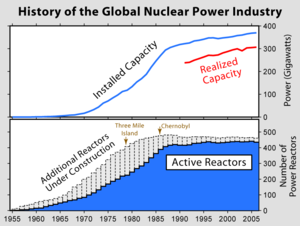
Global history of the use of nuclear power. The Three Mile Island accident is one of the factors cited for the decline of new reactor construction.
According to the IAEA, the Three Mile Island accident was a significant turning point in the global development of nuclear power [49]. From 1963 to 1979, the number of reactors under construction globally increased every year except 1971 and 1978. However, following the event, the number of reactors under construction declined every year from 1980 to 1998. Many similar Babcock and Wilcox reactors on order were canceled — in total, 51 American nuclear reactors were canceled from 1980 to 1984.[50]


